Showing posts with label wool batts. Show all posts

Thursday, February 27, 2014

It's a good day to dye...

Oooh it has been a while since I put anything up here on my blog!  So sorry about that!

With the biting cold of this Wisconsin winter, I've been doing some dye work this month.  It is such fun to work with dye on colored wools, so I shot some pictures of the latest batch of experiments.

I soaked 100 grams of wool from various fleeces in my stash and put them in the dye pot to try out the effect of overdyeing the darker natural colored wools.


The mini trampoline drying rack - because I'm fancy like that.
Here's the whole bunch on my drying rack... a mini trampoline that has lost a few too many springs and attachments due to age, but it makes a dandy drying rack when I put it up on sawhorses!

Clockwise from the top:
1. Corriedale, natural gray "Sierra" in Amethyst.
2. Cormo, white "Poppy" in Amethyst and then as a cleanup for Peacock Blue.
3. Corriedale, natural gray "Sierra" in Peacock Blue.
4. English Leicester Longwool steel gray "Theo" clean up batch in Peacock Blue.
5. English Leicester Longwool steel gray "Theo" in Peacock Blue.

Wool is a protein fiber, so I use acid dyes to color the wool fibers.  Typically, vinegar is used for the acidification of the dye bath, but since I plan to sell these colors, I used citric acid instead since it has no odor and uses a much smaller quantity.  I learned this when I started dying with the Nasty Romney fleece that started this journey.


Speaking of the Nasty Romney, I have had good news that I can finally share!  I had submitted a proposal of the story of that fleece to Spin-Off Magazine quite a while ago, and I was selected for the Spring 2014 issue featuring color.  I'm on page 70 of the magazine, with my article titled "Making Lemonade".  Here is a link to the magazine: Spin-Off Spring 2014


I'll be putting some batts from both this dye batch and the Nasty Romney (now somewhat affectionately named Anastasia for obvious reasons) into my Etsy shop for your perusal and purchase.

Currently also hard at work on another delightful series of batts called the "Magic" series.  All of these batts are full of sparkle and an interesting blend of fibers.

Here's a taste of the series for your pleasure.
 

Wings of Pegasus
Here is the link to the listing in the shop for this batt called Wings of Pegasus.

Thursday, August 16, 2012

So Fine!

Back to spinning... on some super fine Corriedale (yes, really!)
I called my favorite local shepherd (www.frenecreekfarm.com) a little while back and asked about some really fine gray fleece.  She had two on hand, both Corriedale.  I was skeptical, but I went out anyway, since she's never steered me wrong and she has lots of fleece on hand all the time.
I truly couldn't believe what I saw...
This is one of the two fleeces that I bought.  Both Corriedale and both very, very fine wool with abundant crimp.  Also very greasy fleeces, as most fine wools are, so the washing was a bit of an adventure.

I pulled off a small part of one of the fleeces and washed it the normal way I do fleeces.  After it was dry, it still felt sticky, so it got another bath.  Then I put it on the drum carder - mind you, I have a fine fur drum on my carder - and I got a batt full of noils.  

Back to the drawing board...

I took the pitiful, noiled batt and combed some of it to see what would happen.  The resulting nest of fiber is shown above.  Still some waste, but not a total loss as the batt would have been.  I did spin a couple of the nests of combed fiber and they were very nice to spin and quite fine and pleasing singles.

Then I said to myself, "Self, this fiber needs different preparation to be it's very best".  So I set about learning to deal with superfine wools.  Checked some books out of the library, read them, spent a little time in denial and then decided to try lock washing.  I shudder in the face of this kind of fiddly prep just to get the wool clean!  But, armed with a roll of tulle I sewed up the little bags to hold the locks of wool.

After the tulle bags were ready, I went back out to the garage to commune with my fleece.  Took it out of the plastic bag and unrolled it.  Took off some skirting bits that I didn't want to deal with for this kind of process and brought in about 600 grams to attempt my experiment with lock washing.  There is still about half of the fleece in the bag, just in case I want to experiment further.  I also have the other fleece, so there is plenty of wool for me to fiddle with.  I took pictures of the process for my friends over on the Knit Picks Community and I'll share them with you here too.

Here's the setup: nine nursery plant flats and one large tub big enough to hold them all and allow a bit of sloshing around space.  This shot shows the tulle bags with the raw locks stitched inside, in the nusery flat and ready to go into the water.

I stacked up eight flats like this and put an empty one on top to keep everything together and pushed the whole mess down into the soapy water - held it down for a minute or so and brought it up out of the water, and then pushed it down again.

At that point it looked like this and the water was positively filthy... like the first wash on the uncontained fleece the way I usually do my wool washing.
So then I did another wash, and several rinses using this same process, but separating the trays and using the empty tray on top of each one after the first wash.  This was to help each batch of locks get cleaner - at least that is what I hoped would happen!

After all that was done, I took the bags and laid them out on a screen to dry.  I used my mini trampoline for this - put up on sawhorses for good airflow and turned on the ceiling fan to circulate the air around the fleece.  I wasn't sure how much the bags would slow the process, since I usually am able to pull the locks apart as they dry and that can't happen in lock washing.

Here's a shot of the bags drying on the screen.  Nice clear gray, and the dirty tips will come off when I flick card them prior to spinning.  It took a couple days for the bags to be fully dry.  I opened one and flick carded the locks.  I used a small pin brush made for brushing dogs - the kind that looks like fine carding cloth - often called a slicker brush.  Flick carding is a process I hadn't used before.  Grab one end of the lock and brush out the other end with the dog brush until it is nice and fluffy and straight.  Then turn the lock around and do the same thing on the other end.  Remember not to card the fingertips!  It smarts!  I also dug out my old horse shoeing chaps to cover my legs while I did this.  It worked great since it is nice thick leather and I could really get a good push with the brush against the leather.  The flicking pulls out all the tender tip wool and gets out all the vegetable matter in the wool as well.  Very nice preparation and it leaves me with little tufts of fiber that is all lined up in the lock formation and ready to spin.  I started spinning from this preparation - super fine singles and pretty trouble free spinning.  Here's what it looked like after I had a bit of this spun up.

The locks are in front.  Different colors, yes, but I didn't sort for color on this batch of singles.  I wanted to have some variation in the finished yarn.  So I spun the locks as they came up, and there is some variegation in ths singles as you can see.  The singles are super fine, and much stronger than I would have imagined.  I did a chain ply on this bobbin of singles and ended up with 130 yards of chain plied yarn.  I noticed that the yarn was very springy and elastic as it went into its first bath.  As a note, I wind my skeins on a two yard niddy noddy, which I tie in at least four places to keep the yarn organized and easy to untangle after washing.  This means a skein hangs in about a 36" loop when it comes off the niddy noddy.  This skein had a lot of bounce to it, and I expected it to pull up some, but when it was dry it hung in a 24" loop!  I've never had such bouncy yarn!
I re-wound the skein after it dried, since some of the strands were somewhat wayward in the first skein up.  The new skein came out at 120 yards and still has an incredible bounce and springy quality that I've never had in handspun before.  I've got a couple skeins of commercially spun Merino yarn that have a similar feel.  I can't help but wonder if it is the fine wool, the crimp, or the lock spinning that causes this quality in the finished yarn.  Time to do more research into this... in the meantime, I'm enjoying this cottony, next to the skin soft wool that I've made.  Next big decision is what I'll make with it.  Since I have plenty more of this fleece and another fleece that is very similar, there will be much more of this yarn available to me.  Besides - I still have several of the tulle bags left to flick and spin....

Sunday, July 29, 2012

Tour de Fleece recap...

It seems that I go through phases in my fiber art life. Right now I'm in a spinning phase and having a wonderful time!  Just finished Tour de Fleece, which I have never done before.  I had not heard of it until recently, but it is a self-directed spinning challenge that runs at the same time as the Tour de France bicycle race.  Having no interest in sports, I did the challenge for the personal satisfaction.

I participated in three teams, the first one was Knit Picks and I chose to spin a three ply yarn to complete the singles I had spun of "Blue Fleck" colorway from AlohaBlu that I received in a spinning swap a while back. 
Spin swap from AlohaBlu, the Blue Fleck custom dyed roving is in the middle

When I get those precious braids of handpainted roving I like to plan a yarn around them to show their beauty. This particular roving was about two ounces, and I like to have more yarn than that in the event I want more than an accent of the handpaint.  So I made up more batts to match. In this case, I wanted a subtle blend of blues and teals so I combined these fibers into batts: some gray Corriedale from a sheep named "Sierra", some wool top in a colorway "Bluebell" and some hand dyed Firestar in blue and teal.  All of this came from my stash (how cool is that!) so it made me feel extra good about the yarn I was making!  Here's the picture of the finished "Blue Fleck" singles and the stash of the other fibers.
Blue Fleck singles, Bluebell top, Firestar in blue and teal
Sierra Corridale

The finished batts looked like this:
I made four of these at 33 grams each so that I would have two bobbins with well over two ounces each for plying.  I prefer not to have to try and match batts after the fact, because it seems to be like dye lots, where even if I use the same materials and in the same ratios it never looks identical.

Then I started the spinning.  It seemed to take forever since I wanted the final yarn to be pretty fine.  I finished a bit early, which was a relief and did the plying and got this yarn:
It ended up being 600 yards, 160 grams or 5.6 ounces!  No wonder it felt like I had been spinning forever!  I ended up with quite a bit of the blended singles left, so I did an experiment with embellished yarn using sequins strung on sewing thread.  I chain plied it with the two strands held together, very fiddly and time consuming, but I really like the resulting yarn:
It is 36 grams or 1.3 ounces and 92 yards.  At this point, I'm planning to use this yarn set for some kind of outerwear with the sequined yarn for trim.  It isn't soft enough for next to the skin, but it is gorgeous and will wear well.  Haven't decided on knitting or weaving yet, or even what form of garment.  So into the stash it goes for the time being.

Wednesday, May 9, 2012

Spinning in progress...

Busy, busy, busy and always more to do.  But this is what I've been working on.  I showed you the Cormo I was spinning in my last post.  I've spun up about half of what I have on hand and have this pretty little skein to show for it.

The next thing I've been working on is a pretty good sized quantity of batts that I had made of some of the pink Romney from way back when.  I blended it with some great light gray Corriedale from a ewe named Sierra from my favorite shepherd in Colorado.  I also decided to blend in a little bit of white icicle to add some sparkle to the yarn.  My original plan was to knit up a ruffled scarf that I found in Spin Off some time ago.  An odd thing happened as I worked with this blend.  The Corriedale was a little "sticky" to work with. I had washed it quite a while before I actually did anything with it, so it "rested" in that state. Since the blending was already finished, I went ahead and spun it up the way it was.  But I also decided to re-wash some of the fleece that hadn't been used in the blended batts.  Much, much better... feels clean and pleasant again.  I had no idea such a thing could happen with fleece as it sits waiting its turn in my stash.  I'll definitely chalk this up as a learning experience!  I doubt that I could spin a fleece "in the grease" since I found a little stickyness so icky to work with.

Here's a shot of the singles on the spindle and the bobbin that I load the singles onto as they accumulate.  This way I don't end up with a bunch of tiny skeins.
I still have a little more to finish up but I am on the last batt now.  The sparkle of the icicle doesn't really show up on the pictures - most sparkle fibers seem to be pretty camera shy.  I wonder sometimes how people get shots of Angelina that show the multicolor glittery effect.
I made another neat discovery.  There is a virtual knitting/spinning guild of sorts over on the Knit Picks website.  I've just joined up... it should be interesting to see what I find over there.

Until next time....


Monday, May 23, 2011

Color study completed...

100% DD
Nice to finally have this finished.  The last skein is a bit larger than the others since I had some leftover singles from the LNL to use up.  The Dolly Dorset spun very nicely since all the fiber was the same length, so none of the color pooling that happened with the blended skeins.  This kind of study is very useful to keep on hand to predict what heathered colors can be produced from a single dye batch.  In some ways this comes full circle from the initial process of learning to do dyework, since I have now created for myself a simple way to estimate the amounts of colored fiber needed to create a particular shade of heathered yarn using any of the colored wools that I have on hand. 

My personal opinion is that the natural colored wools are far more interesting than white wool dyed to black, gray or brown.  That being the case, I have many black sheep fleeces on hand.  For those who don't know, any sheep that isn't white, is referred to as a black sheep and the wool is processed separately from the white wools - it takes more time for a mill to do this.  Perhaps that is my reasoning for having primarily black sheep in my own flock when I was raising sheep. 

I love happy endings, so this project has been wonderful in so many ways.  Learning new things, creating things from my own skills and being able to keep them and learn more things from them.  What's not to like?

Here's a shot of the whole batch done, and a remembrance shot of the original batts.

Wednesday, May 11, 2011

Experience is what you get when you didn't get what you wanted...

Ahh, the joys of screwing things up... I'm well trained in clothing design.  At least I thought I was.  I did the things I was supposed to: knit the swatch, big enough to take measurements in several spots. Check.  Start knitting, check the gauge again.  Check.

This all went well, started knitting and didn't really think about it much more.  Until the wee hours of Monday night.  Blocked the cardigan pieces, and they kept growing and growing and growing.  Took some measurements - that sweater would fit King Kong.  I did what any sensible person would do - I walked away to keep from doing something horrible to all that knitted work.

It took another day for me to calm down enough to decide what to do next.  Declared it frogged on Ravelry, banished the pattern to the back of the work in progress clipboard, and announced a new project in that yarn.  At that point, I knew I'd be ravelling out the yarn.  Just finished doing that.  In a way, it was cathartic (though disturbing) to see how quickly I could undo the mistake I'd made.

More pondering, and now I'm thinking that I may re-knit the sweater.  A size smaller and on a size smaller needles, making all the changes I thought of as I worked it the first time.  Like doing the knitting in one piece as much as possible.  As I looked over the pattern again, I noticed it had knit up about two sizes too large - certainly not King Kong, but I'd never have worn it the way it was.  So I'll go back to Ravelry, update my projects again and begin again.

Now I have experience...


25% GNR 75% DD
 On the good news front, I finished the 25% Green Nasty Romney (GNR) and 75% Dolly Dorset (DD) skein of the color study.

Vital statistics on this skein:
25% GNR, 75% DD, three times through the carder to blend colors, singles spun clockwise, Navajo plied counterclockwise. 92 yards in this one ounce skein.


50/50 GNR/DD

I got a lot of carding done.  I was getting tired of looking at all that Green Nasty Romney.  So I chose the blend I liked best of the color study and that was the 50/50.  Carded up seven batts of that, about 300 grams total.  Might do some more, but this amount would give me enough to make a nice vest for myself. 


Pink NR, Sierra and white icicle

I also carded up four smallish batts of Pink Nasty Romney, Sierra (silver gray Corriedale) and a little white icicle sparkle fiber.  I've had batts of the Pink and Sierra sitting around for a while, and I got inspired by the Helix Scarf pattern in Spin Off magazine.  I really like the fact that the brilliance of the really hot pink was toned down by the silver gray of Sierra and a bit of sparkle from the icicle fiber.  Should spin up well and knit up to a pretty scarf - enough going on to be interesting, but not so much as to fight with the interest of the ruffling of the scarf.

More good news - got my first Cormo fleece in the mail yesterday.  What lovely stuff that is - washing it up now.  I'll take pictures when it gets dry...

Wednesday, March 23, 2011

Stashdown update...

100% GNR at top, 75% GNR 25% DD at bottom
Two down, three to go.  Here's a shot of the first two skeins in the color study.

I really like this heathered yarn. The DD tones down the brilliance of the green just enough.  Very pleasant tweedy yarn.  The colors didn't blend perfectly and I rather like that feature.  Probably a function of the different staple lengths more than anything.  The GNR is probably about one and a half to twice the length of the DD. Spun well, washed and air dried. The DD didn't really fuzz out much in this blend. I'm expecting more "bounce" as the percentage of DD increases.

Vital statistics of the 75% GNR 25% DD:
100% Wool.  75% Green Nasty Romney, 25% Dolly Dorset.  Batts carded three times to blend colors.  Singles spun clockwise, Navajo plied counterclockwise.  80 yards, 1 ounce skein.

Next up: 50% GNR 50% DD.

Thursday, March 3, 2011

March Stashdown Goal

Ta-daaaaa!  I had an idea (it didn't hurt either...)  For this month, I'm going to do a color gradation study.  I'll do four one-ounce batts in different amounts to test heathering on color tones.  I'll use Dolly for the neutral and the green Nasty Romney for the color. 
Dolly the Dorset

For the first batt, I'll do 100% Green and no Dolly.  Spin it and knit up a swatch to attach.

For the second batt, it will be 75% Green and 25% Dolly.  Spin and swatch.

For the third batt, 50% of each. Spin and swatch.

For the last one, 100% Dolly. Spin and swatch.
Green Nasty Romney

I saw something like this in Deb Menz's book Color in Spinning a long time ago.  My copy is packed away in a box somewhere.  When the weather warms up I'll try to find it and do some more of this kind of testing for myself.  I have a sweater that I just adore that is made up of several heathered yarns, and each color is so much more interesting than a plain, single color yarn.  So I would like to examine some of those possibilities for myself.

Off to the carder...


Wednesday, February 23, 2011

Progress Report...

Busy week... had a birthday and celebrated by contributing to my stash.  I'll shoot photos of that for next time.  But for now, here's what is happening with the LNL and Dolly yarn for the Stashdown.

This shot shows how much (OMG!) LNL is still left on the bobbin and a few of the many batts I'm still spinning to finish up the plied yarn I'm making.  Did a couple small skeins of the "magpie" yarn to use as an accent and there is the swatch again so you can see the whole picture.  I've got about two half bobbins done of the Dolly singles, and I'll ply those tonight for another skein.

One thing about this stashdown - I sure picked a whopper of a target for this goal!  I'm looking at March with a more sensible eye now... I need to remember that I'm still working full time and that the weather is warming up.  Pen orders are starting to come in now too, and I'm thinking about some other turned things that I want to get rolling on - like spindles, small bowls and maybe some other surprises!

Off to spin again!

Tuesday, February 15, 2011

On to the drum carder...

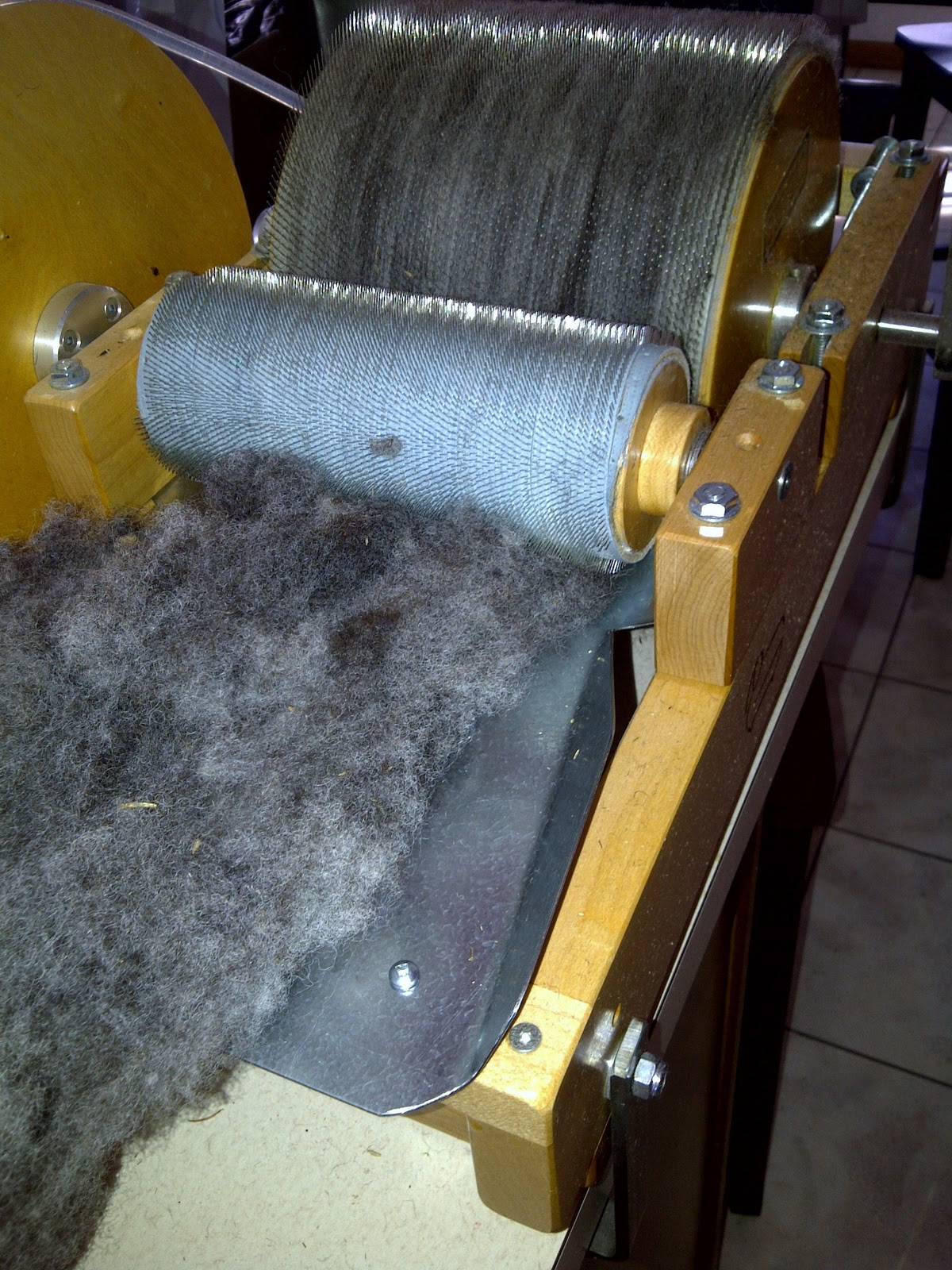
Here's the Dorset cross, time to card it and spin some more of it!  This is one of the nicest uncovered fleeces I've worked with.  Not much veg and so bouncy... I've decided that I really like down wools!  I know that this is a crossbred sheep, so the wool may not behave exactly like purebred down sheep fleece.  The Down sheep that I'm aware of are Suffolk, Hampshire and Dorset. Typical fleeces are dirty, short stapled and low in weight, (usually two or three pounds at best) since these sheep are raised primarily for their meat, not their wool. Down sheep fleeces are supposed to resist felting, which is wonderful for things like socks, which get washed a lot. 

When I raised Suffolks and Corriedales on my own farm I had a customer who bought all the fleeces from one very odd Suffolk ewe that I had.  Her name was Babe, (from the blue ox, not the pig) because she was HUGE.  She also didn't read the same sheep behavior books that I did, since she kicked like a doggone mule when I sheared her!  She was also a lousy mother - had triplets once and lost all three!  But - and this was the only thing that kept her in the flock - she sheared a five inch staple, ten pound fleece!  I still remember packing those fleeces to ship to California - since they don't felt, I could stuff them tight into a box and send them.  The customer was delighted at the way the fleece would leap out of the box - almost like Babe when she was released after shearing.

Enough reminiscing for now, here is a shot of the drum carded batt of the Dorset.  Lovely stuff - I think the shades of gray are my favorite of the dark wools.  I did ten batts, and hoping that will be enough to finish up the Stashdown project for February.  I still have quite a bit of this washed fleece left, and I still have about half of the quantity I bought unwashed. Another project I have planned for this fleece is a mohair blend - beautiful silvery gray locks of the mohair will give this wool a shine that should be fun to work with.  I checked the box the fleece arrived in - there is a name on it, evidently this sheep is named Dolly.  Funny that I get so much more pleasure from the fleece when I know the sheep has a name and not just a number.  Maybe because I named all my sheep too... I miss them so much sometimes.  Ah well, this gives me the chance to have some vicarious enjoyment of sheep farming.  Better yet, now I have the time to spin the wonderful wool!  So much fleece... so little time!