Showing posts with label carding wool. Show all posts

Thursday, January 31, 2013

Rare breed Spin-A-Long - Dorset Down

Brindle Shetland yarn, finished skein 466 yards
Rare breeds of sheep are so interesting.  The Fleece and Fiber Sourcebook by Deb Robson and Carol Ekarius is one of my favorite sources of information on breeds of sheep and the qualities of their wool. Yet it gives only the kind of knowledge that reading provides.  As a spinner, I love the tactile qualities of the wool.  So I was immediately attracted to the Knit Spin Farm Rare Breed Spin-A-Long (SAL) that started back on the first of January.  I mentioned the Shetland that I did as my first project.  Since I posted last, I finished the skein.  It ended up being 40 wraps per inch in the singles and about light fingering weight in the finished chain plied yarn. 

Close up of Brindle Shetland yarn
Statistics: 3.7 ounces, 106 grams. 466 yards of chain ply yarn.  Spun singles clockwise on the Kromski Fantasia, chain plied on the Louet S10 13 treadles.


Dolly Dorset - raw lock from darkest portion of fleece
Now that I've finished the Shetland, I decided to do more with the Rare Breed SAL.  Thought through the list and decided on the Dorset I have in my stash.  Remember Dolly from the color study?  I'm working with her fleece on its own this time.  Took a couple ounces and prepared them on my wool combs to produce a semi-worsted top.  I did not lock wash this fleece, and I'm not concerned about having a fully worsted preparation since this is a down wool.  I wanted to have some fun with the bounce, and by combing I thought I'd be able to reduce the fuzzy factor of the finished yarn somewhat.  This is what the fiber looked like beforehand.

Saving a lock out of the raw fleece is an excellent idea, since I seldom am able to process a whole fleece at the same time.  Typically, I'll do a small sample and start the record keeping in a spinning journal.  The pages aren't in any particular format, but I do try to record things that I do with the fleece. 


Combed nests of Dolly Dorset's fleece
Back to the raw lock, there is a good reason to save it.  The crimp pattern is most obvious in a raw lock that is undisturbed.  In this particular fleece the crimp is very orderly and consistent from end to end.  The brownish tips are somewhat weathered since this fleece was not covered with a sheep coat.  Being a down wool, it should be (and has been) pretty resistant to felting.  This particular lock shows length of about four inches, which is longer than usual for down wools. A happy surprise indeed, since it allows a lot more options for processing and spinning this wool.  I usually use the snack size ziplock bags to preserve the raw lock and make a note of the breed, the name or ear number of the sheep, the source and price and the weight of the fleece and whatever other things I notice at this stage of working with the fleece.  Then I toss the bagged lock back in with the fleece.  As I process the fleece, I tag the bags as I go along so that I don't lose track of which one it is and what I've done with it.  With a raw fleece, I put any notes in a page protector since the grease of the wool will affect the paper - sometimes to the degree of obliterating the notes I've made - not a happy discovery!

Finished skein of combed Dolly Dorset
Down wools come from several breeds of sheep, and the saddest part is that few shepherds that raise them are much concerned with the quality of the fleeces and treat the fleece as more of a nuisance than a profitable product that the sheep are producing.  Perhaps this SAL and others like it can encourage a few more shepherds of these down wool breeds to place more value on these fleeces.  This particular fleece seems to be from a shepherd that does have some care for the spinning quality of the fleeces they are producing.  That being said, the fleece was still quite reasonably priced when I bought it through Ebay.  Many shepherds use Ebay and Etsy to sell their fleeces, and with the exception of the Nasty Romney, I've had little or no trouble with inaccurate descriptions.  Most sellers are very honest about the qualities of their fleeces - sometimes even exaggerating the amount of vegetable matter to be sure the buyers know what they are getting, and discounting the price to make it more appealing if there is veg in the fleece.  Such was the case with Dolly's fleece.  It was described as having some veg, which it did, but not nearly the quantity I was expecting.
Close up of the finished yarn

The spinning was smooth and easy.  The combed preparation drafted smoothly, and I did much less predrafting than I typically do.  I spun with a medium backward draw since the staple length was allowing me to do so. The singles were very fine and the plying went well.  Overall, I continue to be impressed by how well-behaved this fleece is.  Everything just works, smooth and simple. The fiber does shed slightly while spinning, and feels somewhat dry in comparison to other wools I've worked with.  I don't know if this is characteristic of the down wools or not.  I've got an order in to another shepherd for some Dorset roving to test this idea, but being a commercial prep, so I'm not sure the comparison will be valid. 

The statistics on this skein are: 31 grams, 1.1 ounce, 124 yards.  Spun singles clockwise on the Kromski Fantasia and chain plied counterclockwise 13 treadles on the Louet S10. 

Dolly Dorset carded batt
Part of my purpose for this wool in the SAL is to compare combing and carding prep on the same fleece.  I'm looking forward to finishing the woolen prep I did for this study.  I've started on it already, and the main difference I've noticed is that I'm pulling out the neps as I spin.  I rather expected this, since combing removes them before spinning.  Woolen preps mean less waste at the processing step, but more at the spinning step.  Still less overall compared with combing, since it leaves the different fiber lengths in the batt.  Combing sorts out the longest fibers and keeps them well aligned in the top.  It is a trade off in some respects, but the end product can be vastly different.  Since I wanted to test the difference in prep, I'm spinning the singles in the same way, medium backward draw, clockwise on the Kromski and I'm about halfway through the batt.  It looks and feels similar in the singles.  The washing of the plied yarn will tell a better story.  The combed prep seemed less bouncy than I expected after the washing.  The value of doing the two similar skeins side-by-side will show the difference in bounce by the length of the finished skein.  I expect the woolen prep to be much shorter in length since the crimp isn't as altered.  I'll have my answer soon.


Thursday, August 16, 2012

So Fine!

Back to spinning... on some super fine Corriedale (yes, really!)
I called my favorite local shepherd (www.frenecreekfarm.com) a little while back and asked about some really fine gray fleece.  She had two on hand, both Corriedale.  I was skeptical, but I went out anyway, since she's never steered me wrong and she has lots of fleece on hand all the time.
I truly couldn't believe what I saw...
This is one of the two fleeces that I bought.  Both Corriedale and both very, very fine wool with abundant crimp.  Also very greasy fleeces, as most fine wools are, so the washing was a bit of an adventure.

I pulled off a small part of one of the fleeces and washed it the normal way I do fleeces.  After it was dry, it still felt sticky, so it got another bath.  Then I put it on the drum carder - mind you, I have a fine fur drum on my carder - and I got a batt full of noils.  

Back to the drawing board...

I took the pitiful, noiled batt and combed some of it to see what would happen.  The resulting nest of fiber is shown above.  Still some waste, but not a total loss as the batt would have been.  I did spin a couple of the nests of combed fiber and they were very nice to spin and quite fine and pleasing singles.

Then I said to myself, "Self, this fiber needs different preparation to be it's very best".  So I set about learning to deal with superfine wools.  Checked some books out of the library, read them, spent a little time in denial and then decided to try lock washing.  I shudder in the face of this kind of fiddly prep just to get the wool clean!  But, armed with a roll of tulle I sewed up the little bags to hold the locks of wool.

After the tulle bags were ready, I went back out to the garage to commune with my fleece.  Took it out of the plastic bag and unrolled it.  Took off some skirting bits that I didn't want to deal with for this kind of process and brought in about 600 grams to attempt my experiment with lock washing.  There is still about half of the fleece in the bag, just in case I want to experiment further.  I also have the other fleece, so there is plenty of wool for me to fiddle with.  I took pictures of the process for my friends over on the Knit Picks Community and I'll share them with you here too.

Here's the setup: nine nursery plant flats and one large tub big enough to hold them all and allow a bit of sloshing around space.  This shot shows the tulle bags with the raw locks stitched inside, in the nusery flat and ready to go into the water.

I stacked up eight flats like this and put an empty one on top to keep everything together and pushed the whole mess down into the soapy water - held it down for a minute or so and brought it up out of the water, and then pushed it down again.

At that point it looked like this and the water was positively filthy... like the first wash on the uncontained fleece the way I usually do my wool washing.
So then I did another wash, and several rinses using this same process, but separating the trays and using the empty tray on top of each one after the first wash.  This was to help each batch of locks get cleaner - at least that is what I hoped would happen!

After all that was done, I took the bags and laid them out on a screen to dry.  I used my mini trampoline for this - put up on sawhorses for good airflow and turned on the ceiling fan to circulate the air around the fleece.  I wasn't sure how much the bags would slow the process, since I usually am able to pull the locks apart as they dry and that can't happen in lock washing.

Here's a shot of the bags drying on the screen.  Nice clear gray, and the dirty tips will come off when I flick card them prior to spinning.  It took a couple days for the bags to be fully dry.  I opened one and flick carded the locks.  I used a small pin brush made for brushing dogs - the kind that looks like fine carding cloth - often called a slicker brush.  Flick carding is a process I hadn't used before.  Grab one end of the lock and brush out the other end with the dog brush until it is nice and fluffy and straight.  Then turn the lock around and do the same thing on the other end.  Remember not to card the fingertips!  It smarts!  I also dug out my old horse shoeing chaps to cover my legs while I did this.  It worked great since it is nice thick leather and I could really get a good push with the brush against the leather.  The flicking pulls out all the tender tip wool and gets out all the vegetable matter in the wool as well.  Very nice preparation and it leaves me with little tufts of fiber that is all lined up in the lock formation and ready to spin.  I started spinning from this preparation - super fine singles and pretty trouble free spinning.  Here's what it looked like after I had a bit of this spun up.

The locks are in front.  Different colors, yes, but I didn't sort for color on this batch of singles.  I wanted to have some variation in the finished yarn.  So I spun the locks as they came up, and there is some variegation in ths singles as you can see.  The singles are super fine, and much stronger than I would have imagined.  I did a chain ply on this bobbin of singles and ended up with 130 yards of chain plied yarn.  I noticed that the yarn was very springy and elastic as it went into its first bath.  As a note, I wind my skeins on a two yard niddy noddy, which I tie in at least four places to keep the yarn organized and easy to untangle after washing.  This means a skein hangs in about a 36" loop when it comes off the niddy noddy.  This skein had a lot of bounce to it, and I expected it to pull up some, but when it was dry it hung in a 24" loop!  I've never had such bouncy yarn!
I re-wound the skein after it dried, since some of the strands were somewhat wayward in the first skein up.  The new skein came out at 120 yards and still has an incredible bounce and springy quality that I've never had in handspun before.  I've got a couple skeins of commercially spun Merino yarn that have a similar feel.  I can't help but wonder if it is the fine wool, the crimp, or the lock spinning that causes this quality in the finished yarn.  Time to do more research into this... in the meantime, I'm enjoying this cottony, next to the skin soft wool that I've made.  Next big decision is what I'll make with it.  Since I have plenty more of this fleece and another fleece that is very similar, there will be much more of this yarn available to me.  Besides - I still have several of the tulle bags left to flick and spin....

Sunday, July 29, 2012

Tour de Fleece recap...

It seems that I go through phases in my fiber art life. Right now I'm in a spinning phase and having a wonderful time!  Just finished Tour de Fleece, which I have never done before.  I had not heard of it until recently, but it is a self-directed spinning challenge that runs at the same time as the Tour de France bicycle race.  Having no interest in sports, I did the challenge for the personal satisfaction.

I participated in three teams, the first one was Knit Picks and I chose to spin a three ply yarn to complete the singles I had spun of "Blue Fleck" colorway from AlohaBlu that I received in a spinning swap a while back. 
Spin swap from AlohaBlu, the Blue Fleck custom dyed roving is in the middle

When I get those precious braids of handpainted roving I like to plan a yarn around them to show their beauty. This particular roving was about two ounces, and I like to have more yarn than that in the event I want more than an accent of the handpaint.  So I made up more batts to match. In this case, I wanted a subtle blend of blues and teals so I combined these fibers into batts: some gray Corriedale from a sheep named "Sierra", some wool top in a colorway "Bluebell" and some hand dyed Firestar in blue and teal.  All of this came from my stash (how cool is that!) so it made me feel extra good about the yarn I was making!  Here's the picture of the finished "Blue Fleck" singles and the stash of the other fibers.
Blue Fleck singles, Bluebell top, Firestar in blue and teal
Sierra Corridale

The finished batts looked like this:
I made four of these at 33 grams each so that I would have two bobbins with well over two ounces each for plying.  I prefer not to have to try and match batts after the fact, because it seems to be like dye lots, where even if I use the same materials and in the same ratios it never looks identical.

Then I started the spinning.  It seemed to take forever since I wanted the final yarn to be pretty fine.  I finished a bit early, which was a relief and did the plying and got this yarn:
It ended up being 600 yards, 160 grams or 5.6 ounces!  No wonder it felt like I had been spinning forever!  I ended up with quite a bit of the blended singles left, so I did an experiment with embellished yarn using sequins strung on sewing thread.  I chain plied it with the two strands held together, very fiddly and time consuming, but I really like the resulting yarn:
It is 36 grams or 1.3 ounces and 92 yards.  At this point, I'm planning to use this yarn set for some kind of outerwear with the sequined yarn for trim.  It isn't soft enough for next to the skin, but it is gorgeous and will wear well.  Haven't decided on knitting or weaving yet, or even what form of garment.  So into the stash it goes for the time being.

Tuesday, May 3, 2011

Third skein of color study...

Here is the group so far.  The 100% Green Nasty Romney (GNR) is in the back, the middle skein is the 75% GNR/25% Dolly Dorset (DD). The one in front is the 50% GNR/50% DD. 

This color study has been fun to do.  I've still got two more skeins to go, but I like what I'm learning from the process.  Good to know that I can make many shades of yarn from one dye process.  These skeins are also proving that the blending works, even when the two types of wool are vastly different and actually can make the finished yarn more interesting.  The GNR is very long and wavy in structure with a luster, while the DD is a shorter, crimpier wool with a lot of bounce, but very little shine.  The difference in length is also making the heathering more interesting - little "blips" of color appear once in a while, and I find that I rather like that effect.


50% Green Nasty Romney/50% Dolly Dorset
 Here is the newest skein and it's stats:
50% GNR/50% DD, carded batt three times to blend color well.  Singles spun clockwise, Navajo plied counter-clockwise.  Spun singles entirely by handspindle, plied on the wheel.
106 yards, this yarn is a bit finer than the others, somewhat by intent, since I wanted to test the fineness I could reliably attain on the spindle.

I'm pleased with this yarn, I'll be doing more like this for a project I'm planning.

Thursday, March 17, 2011

Spinning of the Green...


Green Nasty Romney on the picker
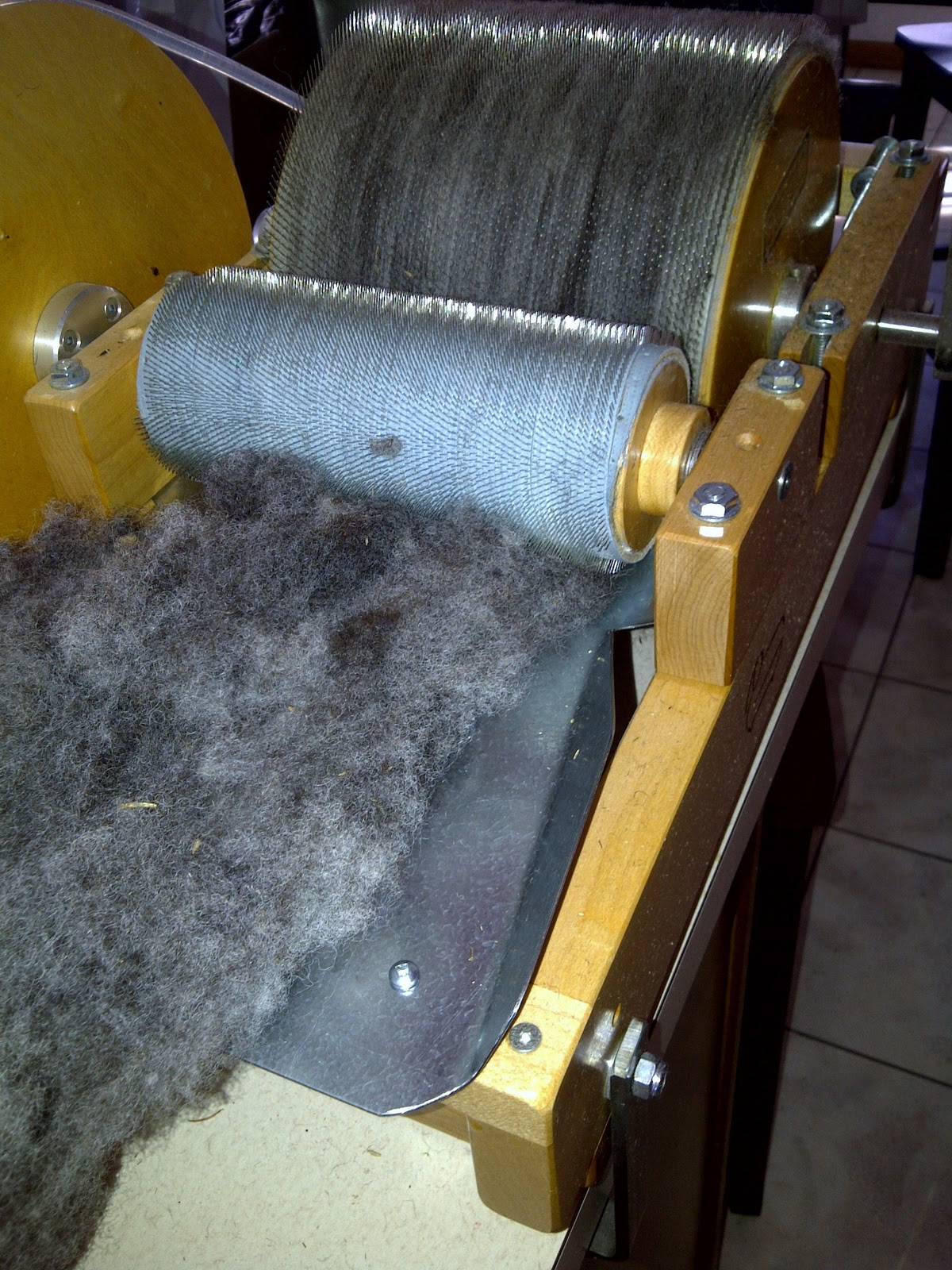
 Here's a Stashdown update.  Picked the Green Nasty Romney. It turns out that it does have pretty long staple, and surprisingly it is somewhat glossy and silky feeling.  Still a lot of veg falling out at this stage.

Weighed out and carded all the batts, ran them through three times to completely blend the colors.  I also noticed that I missed one combination in the original posting, so I did that one too.  I think it was the 25% Green and 75% Gray that was missing from the lineup.

Here's a shot of the completed one ounce batts.
March Stashdown Color Study Batts
From left to right on the picker:
100% Green Nasty Romney (GNR)
75% GNR 25% Dolly Dorset (DD)
50% GNR 50% DD
25% GNR 75% DD
100% DD

Being the orderly sort, I started on the green end and started spinning.  The GNR is a delight to spin, long and silky, still picking out veg and second cuts and a few noils. As I mentioned, not the most impressive fleece I've ever worked with, but it is making up a nice yarn.

Finished up the 100% GNR batt, plied and washed the skein and here's the result:
100% Green Nasty Romney yarn
Details: 84 yards, 1 ounce. Spun singles clockwise, Navajo plied counterclockwise. Hand dyed in the fleece with Dharma #447 Emerald Green Acid dye.

Tuesday, March 15, 2011

Works in progress - Part Three

Here is the beginning of a lace shawlette that I'm doing as a knit-along with my Mom.  I'm doing the Annis shawlette from Knitty.com, here's the link: http://www.knitty.com/ISSUEss10/PATTannis.php
Mom's working hers in Malabrigo Sock in one of the purple/blue colorways.  I'm doing mine in handspun from one of my own Corriedale sheep named "Wiggly". I may have to spin some more, since the yarn I'm using is a bit heavier weight than recommended.  I wanted a wrap with some warmth to it.  I've got a full fleece of another Corriedale named "Sierra" that is the same color.  I'm stalled out at the beginning of the row of bobbles.  I don't like to work bobbles, even though they are a very nice accent on this particular shawlette.  I did a swatch of the lace and did the first bobble in the purist way with my knitting needles, decided that it was a sure road to madness and picked up a crochet hook to finish the swatch.  Since then, more pondering, and I am going to use a cable needle to make it easier still to draw the working yarn through the seven strands on these bobbles.

I also worked on my March Stashdown.  Got the batts carded and the green one is spun, plied and washed.  I'll put up pictures of that for next time.

Thursday, March 3, 2011

March Stashdown Goal

Ta-daaaaa!  I had an idea (it didn't hurt either...)  For this month, I'm going to do a color gradation study.  I'll do four one-ounce batts in different amounts to test heathering on color tones.  I'll use Dolly for the neutral and the green Nasty Romney for the color. 
Dolly the Dorset

For the first batt, I'll do 100% Green and no Dolly.  Spin it and knit up a swatch to attach.

For the second batt, it will be 75% Green and 25% Dolly.  Spin and swatch.

For the third batt, 50% of each. Spin and swatch.

For the last one, 100% Dolly. Spin and swatch.
Green Nasty Romney

I saw something like this in Deb Menz's book Color in Spinning a long time ago.  My copy is packed away in a box somewhere.  When the weather warms up I'll try to find it and do some more of this kind of testing for myself.  I have a sweater that I just adore that is made up of several heathered yarns, and each color is so much more interesting than a plain, single color yarn.  So I would like to examine some of those possibilities for myself.

Off to the carder...


Wednesday, March 2, 2011

Spinnable Stash

So here is the great stuff I found at the wool market!  There were several vendors there, all with wonderful things available for sale.  Since I have waaaaaaay too much fleece on hand, I tried to restrain myself.  Did pretty well - but a couple things followed me home anyway.


Corriedale cross dyed rovings
 These pretty pink/red/burgundy rovings from Frene Creek Farm.  My closest shepherd, she's just outside of town which is very handy!  I need to learn how to do this kind of painted roving, but for now, it is nice to be able to pick it up from Frene Creek.  Besides, she has an amazing collection of fleeces.  Some from her own livestock and some from other shepherds and fiber farms.

She's also got the most amazing lotion bars, I've nearly used mine up.  Guess I'll be making a trip out there again soon to replenish my supply.

Superwash BFL and Alpaca and Silk Top
The other batch of goodies I couldn't resist came from a farm that was new to me.  Bumblebee Acres Fiber Farm in Harvard, Illinois.  A nice superwash BFL handpainted roving in blues/purples/teal with a touch of white left intact. The colorway is called Lincoln Park. Very nice!  Also an exquisite Alpaca and silk top in a colorway called Eeyore's Brooding, in heathered purples/blues/grays.

I suspect the lotion bar will come in very handy when I start spinning the silk.  Haven't spun silk in years, but I remember it being a little hard to handle since it wants to stick to any rough spot on my hands.

Now I need to pick a Stashdown goal for March... what shall I choose?  I'll let you know next time...

Tuesday, February 15, 2011

On to the drum carder...

Here's the Dorset cross, time to card it and spin some more of it!  This is one of the nicest uncovered fleeces I've worked with.  Not much veg and so bouncy... I've decided that I really like down wools!  I know that this is a crossbred sheep, so the wool may not behave exactly like purebred down sheep fleece.  The Down sheep that I'm aware of are Suffolk, Hampshire and Dorset. Typical fleeces are dirty, short stapled and low in weight, (usually two or three pounds at best) since these sheep are raised primarily for their meat, not their wool. Down sheep fleeces are supposed to resist felting, which is wonderful for things like socks, which get washed a lot. 

When I raised Suffolks and Corriedales on my own farm I had a customer who bought all the fleeces from one very odd Suffolk ewe that I had.  Her name was Babe, (from the blue ox, not the pig) because she was HUGE.  She also didn't read the same sheep behavior books that I did, since she kicked like a doggone mule when I sheared her!  She was also a lousy mother - had triplets once and lost all three!  But - and this was the only thing that kept her in the flock - she sheared a five inch staple, ten pound fleece!  I still remember packing those fleeces to ship to California - since they don't felt, I could stuff them tight into a box and send them.  The customer was delighted at the way the fleece would leap out of the box - almost like Babe when she was released after shearing.

Enough reminiscing for now, here is a shot of the drum carded batt of the Dorset.  Lovely stuff - I think the shades of gray are my favorite of the dark wools.  I did ten batts, and hoping that will be enough to finish up the Stashdown project for February.  I still have quite a bit of this washed fleece left, and I still have about half of the quantity I bought unwashed. Another project I have planned for this fleece is a mohair blend - beautiful silvery gray locks of the mohair will give this wool a shine that should be fun to work with.  I checked the box the fleece arrived in - there is a name on it, evidently this sheep is named Dolly.  Funny that I get so much more pleasure from the fleece when I know the sheep has a name and not just a number.  Maybe because I named all my sheep too... I miss them so much sometimes.  Ah well, this gives me the chance to have some vicarious enjoyment of sheep farming.  Better yet, now I have the time to spin the wonderful wool!  So much fleece... so little time!